
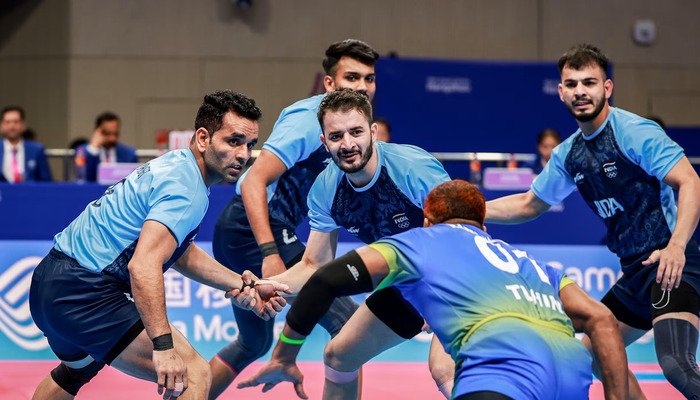
If you are a fan of the Pro Kabaddi League (PKL). You might have noticed that a different style of kabaddi is played in big events like the Asian Games. Now the question is why it looks different from PKL.
You will be surprised to know that it is the same game, but there is a slight difference in rules. These rules make Pro Kabaddi unique and more thrilling than kabaddi in the Asian Games.
Let’s explore these differences in a simple way.
Kabaddi: The Main Idea Is Always the Same
No matter where it is played, the main idea of Kabaddi always stays the same:
- Each team has seven players.
- Raiders have the same kind of duties.
- Defenders try to stop raiders from scoring.
- 30 seconds are allowed for every raid.
- The goal is to score more points than the other team.
Now it’s time to look at the main differences between PKL and Asian Games
Key Differences: PKL Adds More Speed and Action
The Pro Kabaddi League is the urban version of Kabaddi. It was started to make kabaddi more exciting for TV viewers. After 11 successful seasons, PKL has millions of fans all over the world.
To make it more exciting, PKL added some special rules that are not always used in the traditional and international games like the Asian Games.
1. The “Do-or-Die” Raid
Asian Games/Standard Kabaddi: In regular kabaddi or in the Asian Games, if a raider does not score any points, it is just an empty raid. Having few empty raids is a common thing in these kabaddi platforms.
Pro Kabaddi League (PKL): Now here is a big difference. In PKL, if a team has two empty raids, then the third raid becomes a do-or-die raid. A raider has to score a point, and in case a raider fails to get any point, they are out. 1 point is directly given to the defending team for a failed do-or-die raid.
Why it’s cool: This rule makes every third raid super exciting. Raiders have to try and score, which means more action and less waiting. It adds pressure and keeps the game moving fast.
2. The “Super Tackle” Rule
Asian Games/Standard Kabaddi: If the defending team has fewer players on the mat (say, 3 or 4 players) and they successfully stop the raider, they get 1 point, just like any other tackle.
Pro Kabaddi League (PKL): But in Pro Kabaddi, in this type of situation, the defending team gets 2 points. This type of tackle is called a Super Tackle.
Why it’s cool: It gives the team with fewer players a big chance to score extra points and come back into the game. It makes defence even more thrilling when a team is down in numbers.
3. Court Markings (Bonus Line Use)
Asian Games/Standard Kabaddi: The bonus line is used, and a raider can get a bonus point if they cross it correctly with at least 6 defenders on the mat.
Pro Kabaddi League (PKL): The bonus line works very similarly in PKL. However, the conditions for when it’s active (when a bonus point can be taken) can sometimes have very slight variations in different tournaments. The general rule of needing 6 or 7 defenders on the mat for the bonus to be active remains largely the same.
4. Time Limits for Raids
Asian Games/Standard Kabaddi: Traditionally, the raider had to complete the raid on “one breath” (chanting “Kabaddi” continuously). While a 30-second clock is now common, older versions didn’t always have a strict timer.
Pro Kabaddi League (PKL): Every raid in PKL has a strict 30-second time limit. If the raider doesn’t return to their half within 30 seconds, even if they aren’t tackled, they are “out,” and the defending team gets a point.
Why it’s cool: This speeds up the game a lot! It prevents raiders from wasting time and forces them to make quick moves.
Why These Differences?
The organisers of Pro Kabaddi made these essential changes in the league to make it more interesting for viewers.
PKL has a unique points system for choosing the winning team. These rules are missing in the Kabaddi at the Asian Games. They still follow the old-school kabaddi rule.
With time everything needs some kind of improvement. PKL realised that, and they came up with a new kind of kabaddi.
Asian Games Kabaddi is played under standard international rules. So, the next time you watch Kabaddi, you’ll know exactly why some games feel extra fast and full of surprises!

“Rohit is a seasoned sports journalist with over 5 years of experience specializing in Indian sports. He has built a reputation for his deep-dive analysis of the Pro Kabaddi League (PKL) and domestic Indian Cricket. From tracking player auctions to breaking down match-winning strategies, Rohit provides fans with expert insights grounded in years of on-ground reporting and statistical analysis.